The American song tradition
Direct melodies, narrative instinct and songs built to travel beyond the room they were written in.
Exploring distance, memory, movement and imagined places.
Songs rooted in American songwriting, carried by guitars, melody and atmosphere.
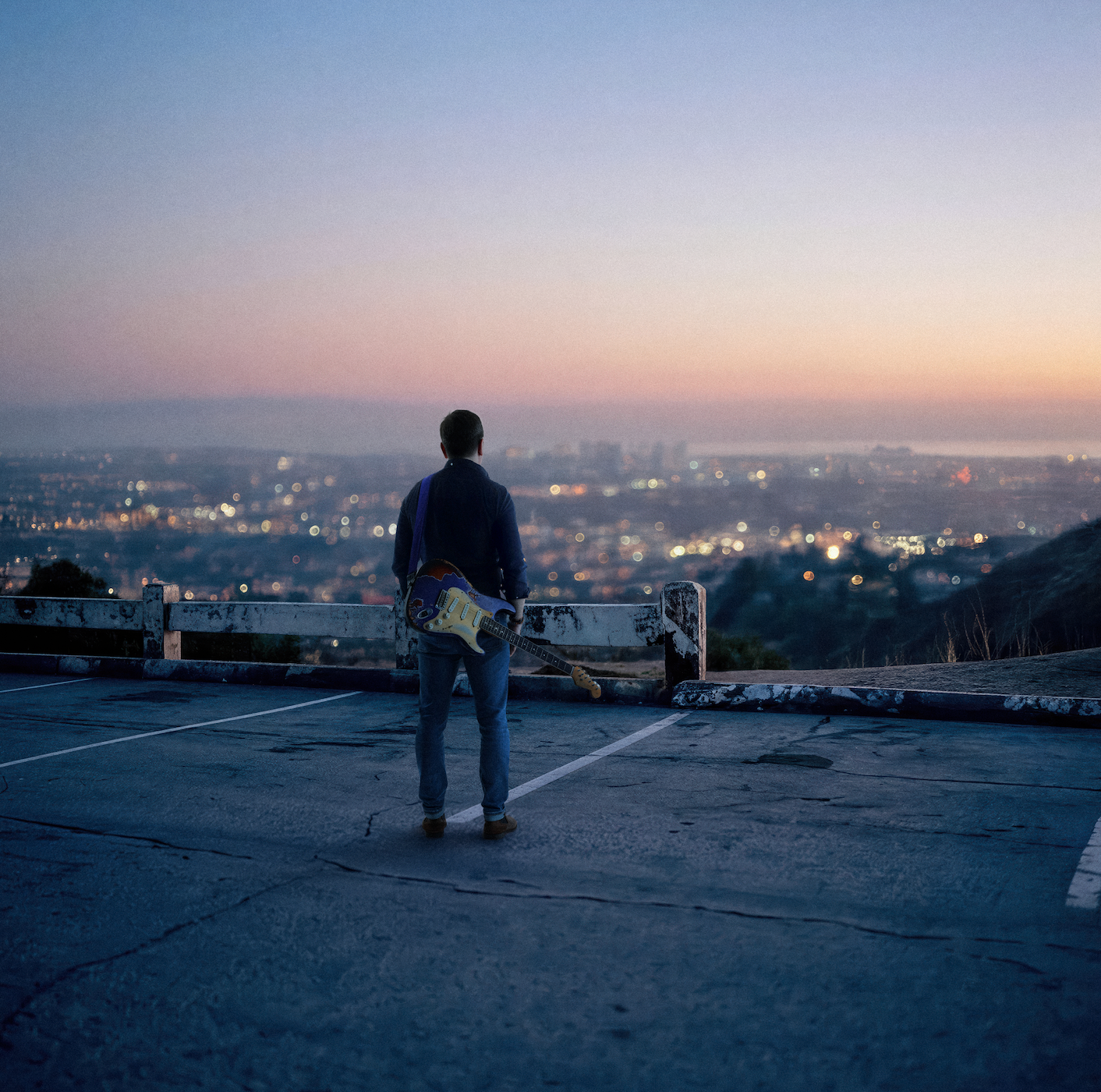
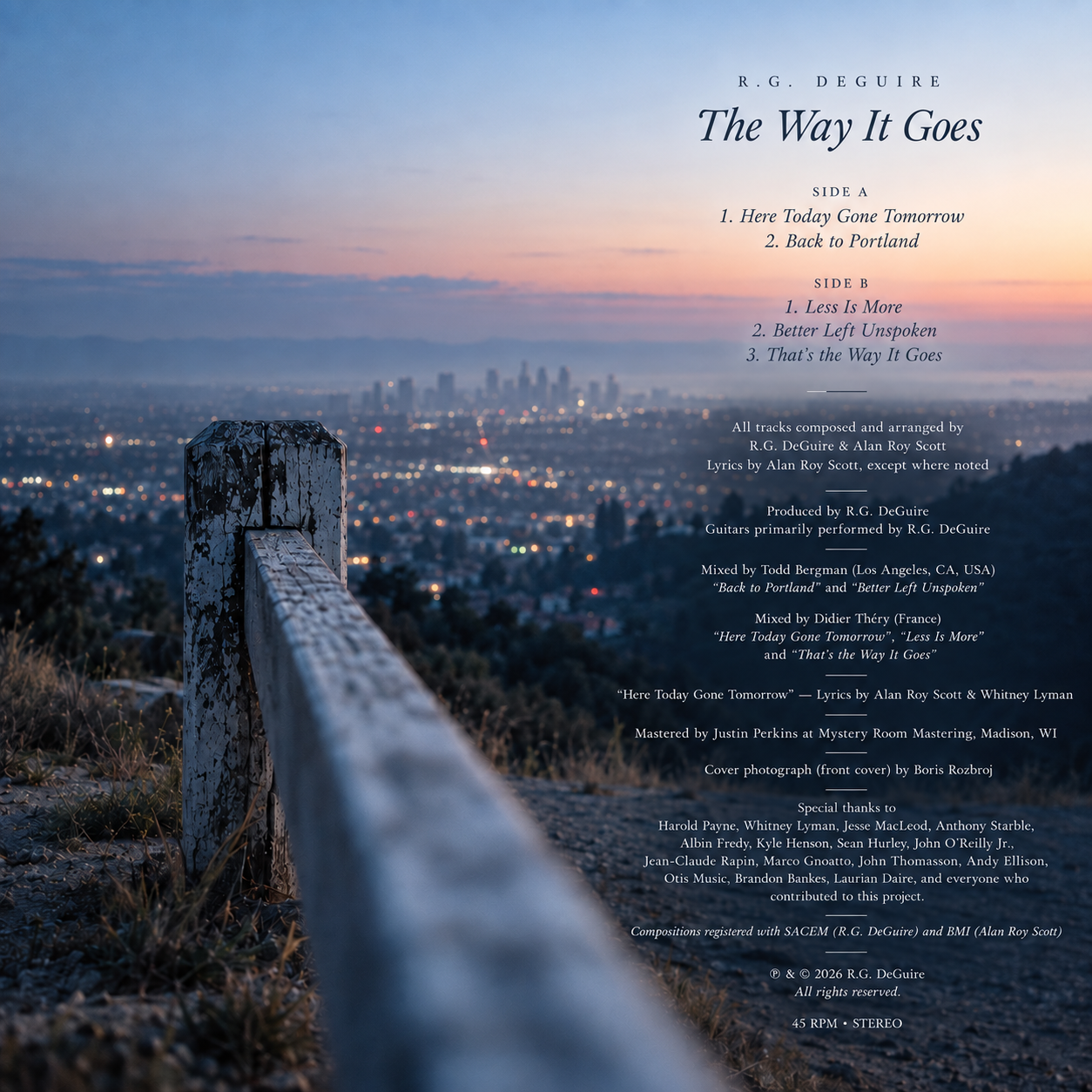
The Way It Goes is a five-song EP created with American songwriter Alan Roy Scott. Rooted in the melodic tradition of the American West Coast, it moves between melodic rock, soft rock and Americana — warm guitars, vocal harmonies and songs given room to breathe. Across stories of time, home, love, disappointment and acceptance, one idea keeps returning: life rarely follows the route we imagine.
Lyrics by Alan Roy Scott, except “Here Today Gone Tomorrow” by Alan Roy Scott & Whitney Lyman.
R.G. DeGuire brings the melodic tradition of the American West Coast into a cinematic Americana landscape. Warm guitars, human performances, vocal harmonies and strong melodies move between melodic rock, soft rock and Americana without trying to recreate another era.
The guitar sometimes leads, sometimes answers the voice and sometimes takes over when the words have said enough. The song always comes first.
Direct melodies, narrative instinct and songs built to travel beyond the room they were written in.
Six strings, open space, a little distance. The guitar is woven into the songs as melody, texture and feeling.
Distance, haze, roads, lights and imagined places turn each track into a different entry point into the same world.
R.G. DeGuire is a French songwriter, guitarist and producer making cinematic songs rooted in Americana, melodic rock and the mythology of the American West Coast.
The project grew out of a long-distance creative exchange between France and the United States, eventually bringing R.G. together with American songwriter Alan Roy Scott. What began as a musical correspondence became an important part of R.G.’s evolution as a songwriter, helping shape a more personal voice and a sound of his own.
Somewhere along the way, a cinematic quality began to emerge. Everyday stories, fragments of memory and imagined places found their way into the songs, often circling around distance, movement, identity and the strange feeling of belonging to somewhere you may never have been.
Inspired by American songwriting, road movies and the landscapes of the West Coast, R.G. draws from the timeless side of American rock — melodic, organic and atmospheric, with the guitar often carrying as much of the story as the words.
The result is a personal take on Americana: an imagined America seen from across the Atlantic, shaped as much by records and films as by memory, longing and the places we carry with us.
Artist biography and full press notes for The Way It Goes.
R.G. DeGuire is a French songwriter, guitarist and producer whose musical identity was shaped early on by the American records that filled his family home. Songwriters such as James Taylor and Jackson Browne, alongside the unmistakably American sound of the Doobie Brothers and the Eagles, became part of his musical vocabulary long before he began defining a sound of his own.
Later came country music, discovered late at night on French radio through shows playing the latest Nashville releases and the US Billboard charts. Those different worlds gradually came together, leaving an imprint that can be heard today in his songwriting — a connection to American music built from thousands of miles away.
For R.G., the guitar is an extension of himself. It is another voice within the songs, sometimes answering the vocal, sometimes carrying what words cannot. But it never exists at the expense of the song itself. His music is built around balance — between voice, guitars, rhythm, harmony and space — with melody always at its heart.
The Way It Goes, created with American songwriter Alan Roy Scott, brings those influences and years of musical exploration together in five songs that feel less like a tribute to a particular sound or era than the natural expression of a musical identity formed over time.
Long before R.G. DeGuire ever thought about defining his own sound, American music was already part of his world.
Growing up in France surrounded by records, he was drawn early to the songwriting of James Taylor and Jackson Browne, the harmonies and musicianship of the Eagles and the Doobie Brothers, and later to the new country records he discovered late at night through French radio broadcasts of the American charts.
Those records didn't simply shape his musical tastes. Over time, they became part of his own musical language.
That connection runs through The Way It Goes, a five-track EP created with American songwriter Alan Roy Scott. Rather than trying to recreate a particular period of American music, DeGuire draws from what stayed with him: strong melodies, songs with stories, vocal harmonies, warm guitars and arrangements where every instrument has a reason to be there.
The result sits somewhere between West Coast melodic rock, soft rock and Americana, surrounded by a wider cinematic landscape of distant cities, open roads, relationships, homecomings and lives that don't always unfold according to plan.
But beneath the sound of the record lies another connection.
All five songs are, in different ways, about what happens when certainty begins to disappear.
“Here Today Gone Tomorrow” opens the record by confronting the most unavoidable thing of all: time. Against a bright, melodic arrangement, the song looks beyond the noise, fear and regrets that consume everyday life and turns instead towards the present — the people around us, the moments we still have and the things that matter while they are here.
“Back to Portland” takes that idea onto the road.
It is the EP's most overtly cinematic story: a man leaves Portland for Hollywood, following both a relationship and the promise of a different life. But the California dream gradually becomes something else. Hollywood loses its shine, the relationship falls apart and the road north becomes a journey back towards something more authentic.
Portland is no longer simply a city.
It becomes home, memory and the possibility of becoming yourself again.
On “Less Is More”, the journey turns inward. A narrator who once believed that bigger, brighter and more were synonymous with a better life discovers another kind of richness through love — simplicity, tranquility and the intimacy of not having to fill every silence.
“Better Left Unspoken” approaches that same silence from a more experienced and slightly humorous perspective. Relationships aren't problems that can always be solved by adding more words. Sometimes maturity lies in knowing when to speak, when to listen and when to leave something alone.
Then comes “That's the Way It Goes”.
The closing track begins with someone convinced that he has always controlled his own path. He has avoided being caught off guard, particularly in love. Then someone arrives who changes the rules completely.
For once, losing control isn't failure.
It's the point.
Taken together, the five songs form an understated emotional progression:
Live. Return. Simplify. Learn. Accept.
They weren't designed as chapters of a concept album, yet they repeatedly arrive at the same realization.
Time cannot be stopped.
The dream you chase may not be the life you need.
More isn't necessarily better.
Not everything needs to be said.
And some of the most important things that happen to us are the things we never planned.
That is where the title The Way It Goes takes on a meaning beyond the closing song.
It isn't resignation and it isn't cynicism. It is the perspective that comes from experience: understanding that life rarely follows a straight line, and that sometimes the unexpected road is where the story actually begins.
The guitar is central to DeGuire's music, but these are not guitar-driven songs in the conventional sense.
For him, the instrument is closer to another voice.
Across the EP, guitars move in and around the arrangements rather than sitting on top of them. They answer vocal lines, introduce melodies, create atmosphere and sometimes continue the conversation after the lyrics have stopped.
That restraint is part of the record's musical identity.
The songs come first.
The musicianship is there to serve them.
It reflects a philosophy DeGuire has carried with him from the records that first inspired him: the strength of a song doesn't come from any single instrument dominating the others, but from the balance between them — and from a melody strong enough to remain when everything else is stripped away.
The Way It Goes is also the product of a creative relationship that crosses the Atlantic.
The five tracks were composed and arranged by R.G. DeGuire and American songwriter Alan Roy Scott, with lyrics by Scott, except “Here Today Gone Tomorrow”, written by Scott with Whitney Lyman.
DeGuire produced the EP and performed the majority of its guitar parts.
Two tracks — “Back to Portland” and “Better Left Unspoken” — were mixed by Todd Bergman in Los Angeles, while Didier Théry mixed “Here Today Gone Tomorrow”, “Less Is More” and “That's the Way It Goes” in France.
The record was mastered by Justin Perkins at Mystery Room Mastering in Madison, Wisconsin.
That transatlantic story matters, but The Way It Goes isn't an attempt by a French artist to imitate an American record.
The connection goes further back than that.
The America surrounding The Way It Goes therefore exists somewhere between the real and the imagined.
Portland is real. Hollywood is real. Los Angeles is real.
But within these songs they also become emotional landscapes: places onto which characters project ambition, disappointment, love, escape and the possibility of beginning again.
That space between geography and imagination is where the cinematic Americana dimension of R.G. DeGuire's world emerges.
Five songs about different moments in life.
Five stories connected by the realization that the road ahead rarely looks exactly like the one we imagined.
Warm guitars. Human performances. Strong melodies.
And somewhere between the American West Coast that first existed through records and the experiences accumulated along the way, R.G. DeGuire has found a landscape of his own.
The Way It Goes is a record about time, home, love, disappointment and acceptance.
About the roads we choose.
The turns we don't.
And the places they eventually lead us.